Crafting Connections: nonfiction
Showing posts with label nonfiction. Show all posts

Text Structures: A Lesson for Upper Elementary Students

Wednesday, October 19, 2016
Informational text structures... this was the ELA topic that scared me the most when I was coteaching in upper elementary classrooms. Over the years, though, I've become more comfortable with the topic, and today I want to share a complete text structures lesson with you. To be completely honest, I've received such positive, thoughtful feedback about my free character traits lesson, that I decided to create a similar text structure lesson for my followers, too!  If you read through this post, and decide that you want to try this activity with your students, be sure to click on the following image. Everything you need for this lesson is FREE! (Well, almost everything… you’ll have to provide your own anchor chart paper and clipboards!)
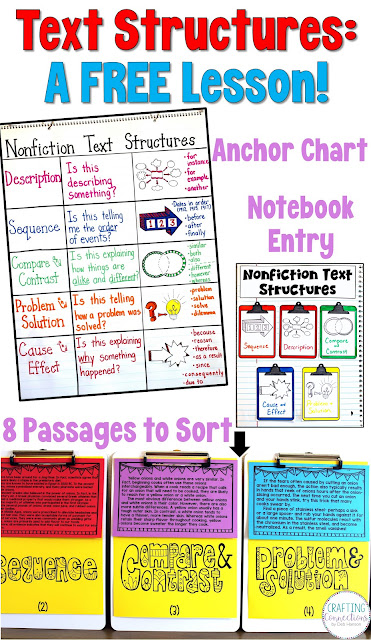
Teach text structures with this nonfiction text structure anchor chart and FREE sorting activity! Ideal lesson for the upper elementary classroom that includes 8 free passages!

I would plan to do this lesson about halfway through my text structure unit. (I would show students my PowerPoint and work through my flipbook before this lesson would take place. By doing these activities first, students should have all of the prior knowledge necessary to fully participate in this review lesson.) I would prepare for this lesson by drawing the base of my text structure anchor chart (the rows and columns would be drawn, and the left column would be labeled). I would also have the passages printed, the interactive notebook copies printed, and the clipboards ready to go.

To begin the lesson, I would share the unfinished anchor chart with students and follow these steps:
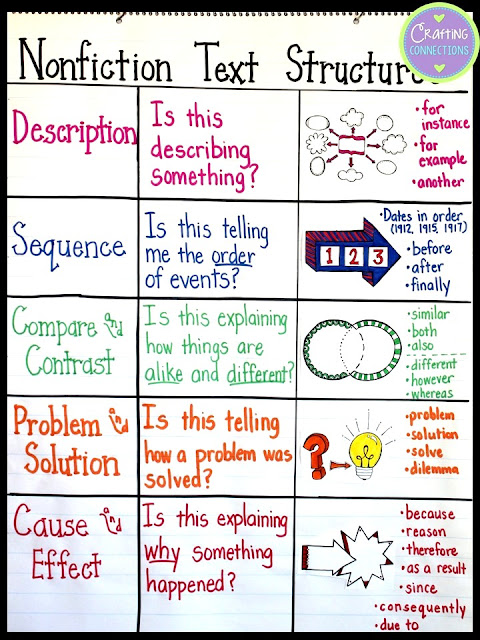
  1.  Hold up one of the images, and ask students to tell me which row it belonged in. 
  2.  Glue the first image in place. 
  3.  Ask students to help me think of a guiding question for that text structure that I could write in  the middle column.
  4.  Instruct students to turn to a partner and list some of the signal words we have learned for that  text structure.
  5.  Tell students that I'm going to jot down a few of the words I heard mentioned during the  partner conversations that just took place, and do so beside the image (as shown).
  6.  Repeat the previous five steps with the other four text structures.
Teach text structures with this nonfiction text structure anchor chart and FREE sorting activity! Ideal lesson for the upper elementary classroom that includes 8 free passages!


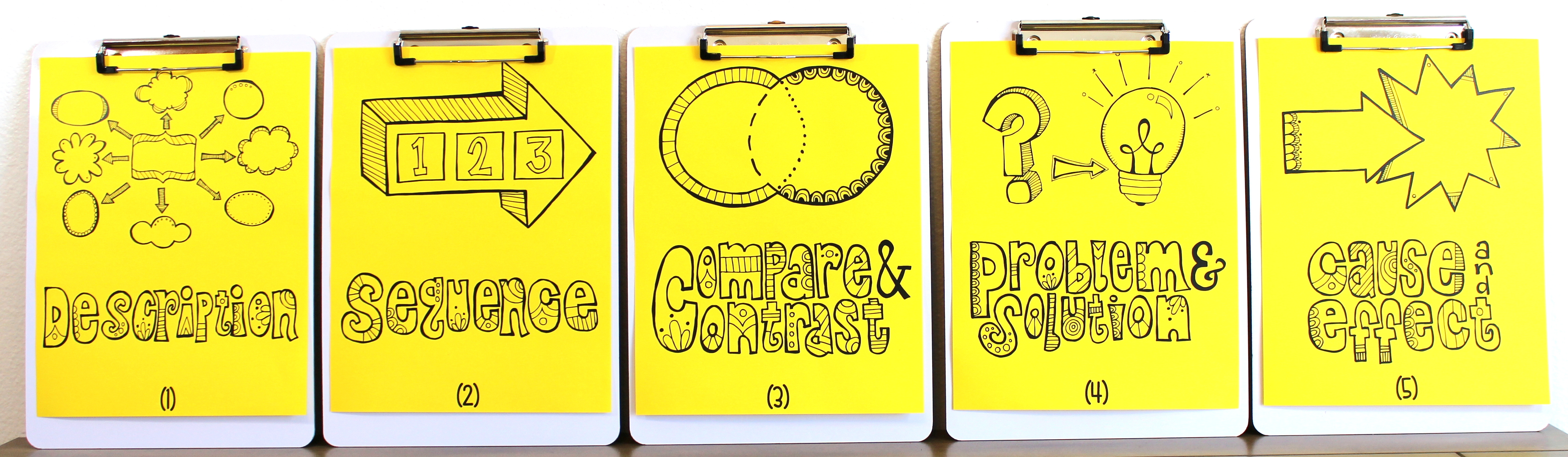
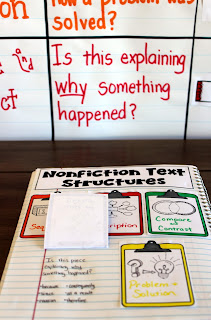
The next component of this lesson includes these five clipboards. As you can see, each clipboard is labeled with the name of a text structure and its matching graphic. I also assigned a number to each clipboard.
Teach text structures with this FREE sorting activity that features 8 nonfiction passages! Ideal text structure lesson for the upper elementary classroom that includes an anchor chart!


Teach text structures with this FREE sorting activity that features 8 nonfiction passages! Ideal text structure lesson for the upper elementary classroom that includes an anchor chart!

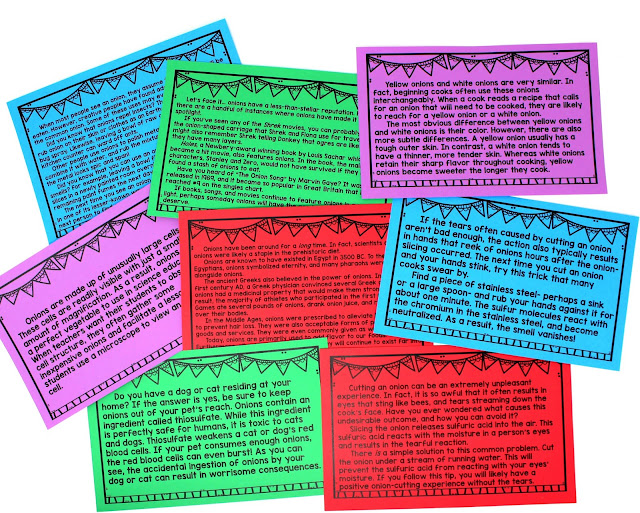
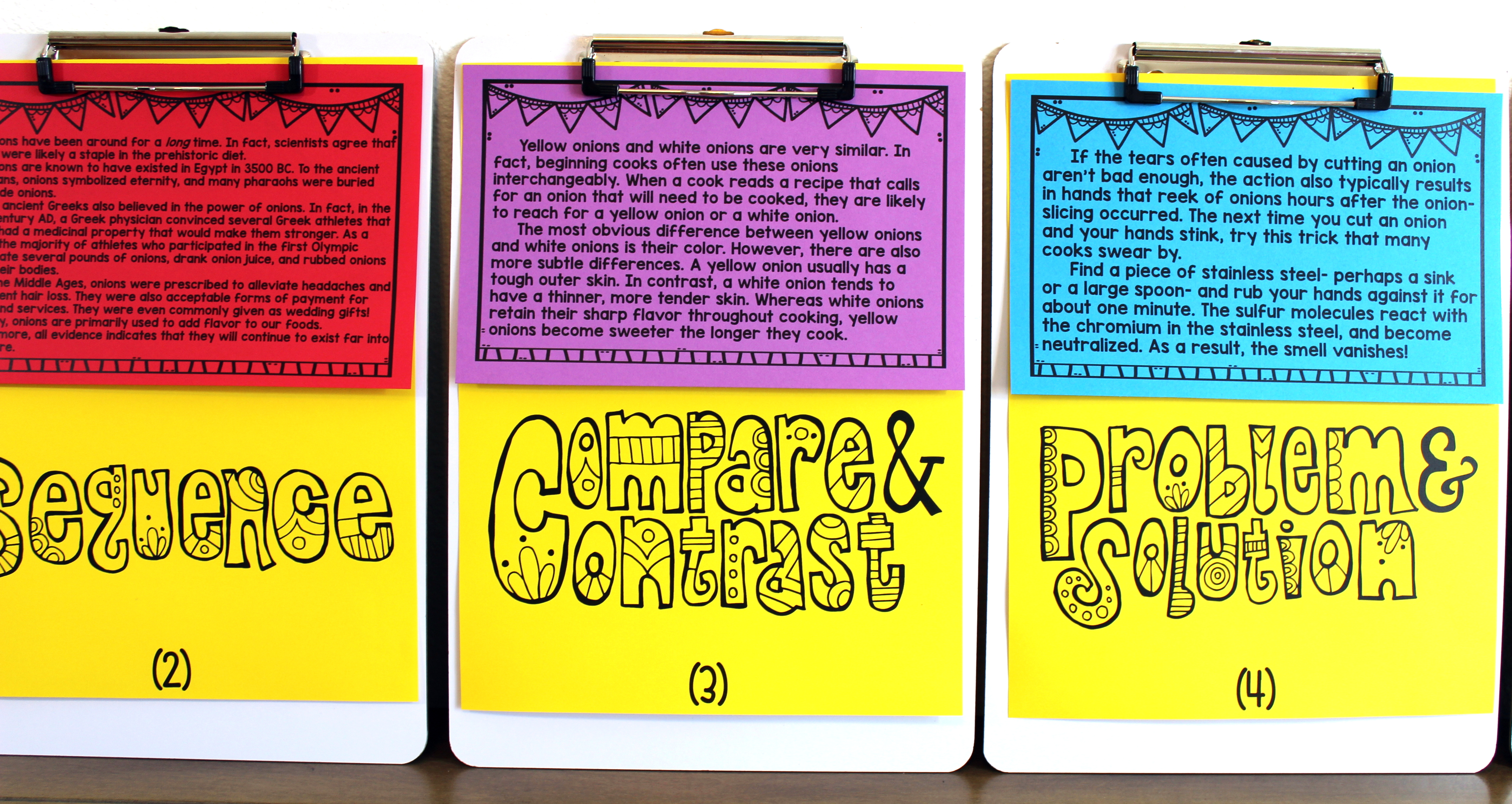
I would tell students to listen carefully as I read aloud a passage. (I would also use a document camera to display the passages so my students could follow along.) After reading the nonfiction passage, students need to identify the text structure used by the author. To make sure everyone remains engaged, I would instruct students to display each answer by holding up fingers… one finger for description, two fingers for sequence, three fingers for compare and contrast, etc. After asking a few students to justify their answer (hopefully by using some of the language from our anchor chart), I would invite a student to clip the passage onto the correct clipboard.
Teach text structures with this FREE sorting activity that features 8 nonfiction passages! Ideal text structure lesson for the upper elementary classroom that includes an anchor chart!


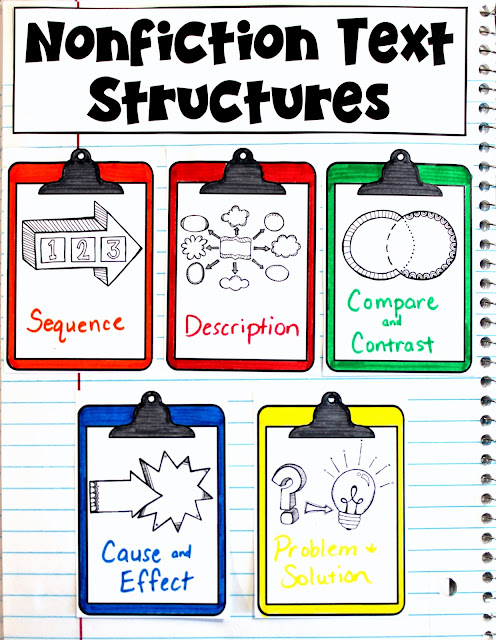
Finally, I would have my students add the following clipboard images to their reading notebooks. Students can refer to the anchor chart as they write the guided question under each clipboard.
FREE Nonfiction Text Structures Interactive Notebook Entry! This blog post contains a COMPLETE informational text structure lesson with and anchor chart and 8 free nonfiction passages for your upper elementary students to sort, also!

(Notice that only the top of each clipboard is glued in place, allowing it to be flipped up and written beneath.)
FREE Nonfiction Text Structures Interactive Notebook Entry! This blog post contains a COMPLETE informational text structure lesson with and anchor chart and 8 free nonfiction passages for your upper elementary students to sort, also!

If you are looking for additional resources for teaching text structures to your upper elementary students, feel free to check out the following resources. 


Thank you for stopping by today! 


Pin for later:
Teach text structures with this FREE sorting activity that features 8 nonfiction passages! Ideal text structure lesson for the upper elementary classroom that includes an anchor chart!

Nonfiction Text Features Anchor Chart (including a freebie!)

Monday, June 20, 2016
If you've been following my blog for a while, you know that I am addicted to anchor charts. I think it's the ESL teacher in me... I like the idea of having a visual reference available in the classroom for those kiddos who need it.

There are so many great nonfiction text feature anchor charts on Pinterest, and I've recreated several of them over the years for my own classroom use. The one I am going to share with you today, however, is a near-replica of one I created myself one year after realizing that many of my ELLs were confusing the index and the glossary.
Nonfiction Text Features Anchor Chart plus tips for teaching students about text features. Download the FREE packet so that you can recreate this anchor chart for your own students.

As you can see, this anchor chart compares and contrasts the four text features that are actually full pages in a nonfiction book. When using this anchor chart as part of a lesson, I recommend having everything except the definitions on the anchor chart when you begin class. When I begin the lesson, my students and I study one image at a time, and I ask students to share what they notice about that page (I jot their ideas on the board in the form of a bullet list). Yes, sometimes I have to "steer" the discussion in a certain direction to help them notice certain aspects of the text feature. After a brief discussion, I write a definition below the image.
Use these FREE printables to teach your students about an index, glossary, table of contents, and title page in a nonfiction book. Use these materials to create a nonficiton text features anchor chart!
If you would like to download the four text feature examples I glued onto my anchor chart, just click HERE. (It's free!)

I would like to share one more tip with you about guiding readers to use nonfiction text features as they read. When I was younger, I remember struggling to know exactly when I should be looking at the various text features on a given page. Do you read the text before looking at the text features (like diagrams, text boxes, etc.) on the page? Do you scan the text features after reading the text? I must confess that I used to do the latter... read the entire chapter, and then go back and scan the text features. I did it as a way to check myself for understanding. Then, during a professional development experience near the beginning of my teaching career, a speaker recommended that we teachers direct students to preview text features as a prereading strategy! When I learned this, I had to restrain myself from slapping my forehead with the palm of my hand. That makes so much sense... why hadn't I thought of that before?  In college, I had learned about doing a "picture walk" with beginning readers before beginning a fiction book. This is an easy and effective way to frontload vocabulary and have them make predictions. It makes perfect sense to do a "text feature walk" with readers at all levels before beginning a nonfiction book for those very same reasons!

I have found that this strategy works so well... for myself and my students! I would love to hear your experiences with this strategy, or if you have another tip that works well with teaching students how to use nonfiction text features!

Click on this image to preview my text features bundle, or to check out an of the individual items seen below.
Nonfiction Text Features... a bundle of resources included a PowerPoint, task cards, posters, assessments, activities, and more!


Thank you for stopping by today!

~Deb
Powered by Blogger.
Back to Top