Crafting Connections: Read Alouds
Showing posts with label Read Alouds. Show all posts

Building Writers with Mentor Texts: Focusing on Sentence Fluency

Thursday, February 28, 2019
A few weeks ago, when I was looking for a book that displayed strong examples of sentence fluency, I stumbled across the most amazing book! I had never seen it before, nor had I ever heard the remarkable true story of Irena Sendler. I am very excited to share it with you today! Besides having excellent examples of sentence fluency, it is truly an inspirational and unforgettable story. (Full disclosure: Amazon links follow.) Also, since sentence fluency is a rather advanced writing trait, this lesson was designed with 4th through 6th grade students in mind.
Sentence fluency is a challenging writing trait to teach. Check out this blog post that features a sentence fluency lesson complete with a mentor text Jars of Hope and a FREE handout!

Book Summary

Irena Sendler was a 19-year-old girl living in Poland when the Nazis invaded her country and forced 500,000 Jewish people into the Warsaw Ghetto, a space less than 2 square miles. As a social worker, she was allowed to enter the ghetto. When she saw how the Jewish people were being treated inside the ghetto, she was determined to help as many as she could. She snuck food and medical supplies into the ghetto. Eventually, she realized that the Jews were being sent to death camps. She began to smuggle children out of the Warsaw Ghetto. She wrote down the names of each child and their parents, hoping that they'd someday be able to be reunited. She put the lists in jars and buried them in the ground. In all, she helped save the lives of 2500 children.
Sentence fluency is a challenging writing trait to teach. Check out this blog post that features a sentence fluency lesson complete with the mentor text Jars of Hope and a FREE handout!
Click here to check out this book.

First Reading: Identify the theme.

Because this book has such a powerful message, I recommend reading this book aloud to your students twice. First, read it with the purpose of teaching your students about the somber realities of the Holocaust in world history. After you have finished reading the book aloud and have discussed it, ask your students to identify a possible theme of the story. I believe the following two quotes from the book explicitly point to the overall themes:
  • "There are two kinds of people in this world, good and bad. It doesn't matter if they are rich or poor; what religion or race. What matters is if they are good or bad."  - page 3
  • "When someone is drowning... give them your hand." - page 5

Second Reading: Identify examples of sentence fluency.

Begin by telling your students that another reason you wanted to share this book with them is that you wanted to point out the author's superb use of sentence fluency. Ask if anyone noticed any patterns regarding the first sentence on each page. If necessary, page through the book and read a few of them. Students will quickly realize that almost every sentence is extremely short... anywhere from 2 to 6 words. Remind students that one way writers try to achieve sentence fluency is by varying the length of their sentences. In this book, the author uses these short sentences to impact the reader by stressing the importance of Irena's selfless actions.
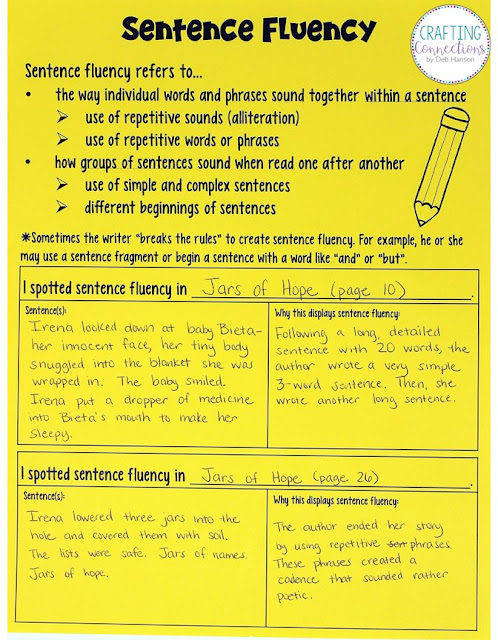
At this point, I recommend distributing the sentence fluency handout. (Click here to download it for free!) As you can see, the top of the handout defines sentence fluency and lists some concrete strategies writers use to achieve sentence fluency. Before beginning your second reading of Jars of Hope, go over the top part of this handout with your students. Then tell your students that you will be reading Jars of Hope a second time with the distinct purpose of identifying how the author achieved sentence fluency.
Sentence fluency is a challenging writing trait to teach. Check out this blog post that features a sentence fluency lesson complete with a mentor text and this FREE handout!

Stop throughout the book and ask students to point out places where the author achieved sentence fluency in a unique way. The following images show places where you might consider stopping.
On page 3, the second to last sentence contains alliteration, which makes the sentence sound smooth and fluent.

Sentence fluency is a challenging writing trait to teach. Check out this blog post that features a sentence fluency lesson complete with a mentor text and a FREE handout!
On page 22, the final sentence shows an example of how the author began a sentence with the word "but". This breaks a grammar rule, but the author purposely did this to add an element of sentence fluency to the page.

Sentence fluency is a challenging writing trait to teach. Check out this blog post that features a sentence fluency lesson complete with a mentor text and a FREE handout!
Page 23 shows how the author began her sentences in different ways. The author could have begun each sentence with "she". (She worked 12 hours a day scrubbing laundry in prison. She was questioned and beaten... She got very little food. She couldn't get a good night's sleep. She was in prison for 3 months.) Instead, the author created sentence fluency by varying her sentences.


After finishing the second reading of the book, return to the handout. Model how to complete the bottom of the handout by picking out examples of sentence fluency from Jars of Hope and recording them on the handout.
Sentence fluency is a challenging writing trait to teach. Check out this blog post that features a sentence fluency lesson complete with a mentor text and a FREE handout!


For an assignment, you can instruct students to find strong examples of sentence fluency in other books, and record them on the handout. Then, the next day you can ask students to share their discoveries.

Finally, if you're interested in winning this book, enter the Rafflecopter below!


I would love to add a few more titles to my lists of mentor texts related to sentence fluency. In the comments below, please share some books you have found that exhibit sentence fluency! Also, don't forget to hop around to the other blogs in this link-up to read about additional mentor texts related to writing!


Pin for later:
Sentence fluency is a challenging writing trait to teach. Check out this blog post that features a sentence fluency lesson complete with a mentor text and a FREE handout!

Lailah's Lunchbox: A Mentor Text Activity that Focuses on Asking Higher-Level Questions

Thursday, October 11, 2018

Lailah's Lunchbox: A Ramadan Story- This book is featured as a mentor text activity for teaching students how to ask higher-level questions. Includes a FREE follow-up worksheet!

Welcome to our Celebrating Diversity mentor text link-up! The book I'm choosing to feature is Lailah's Lunchbox: A Ramadan Story by Reem Faruqi. This is a powerful read-aloud that will touch everyone in your classroom. Your Muslim students will be excited to find a proud, strong Muslim main character that may be facing difficult situations similar to the ones they face on a daily basis. Furthermore, your non-Muslim students will connect with a character much like themselves, as well, who worries about her classmates' and teacher's opinion of her. The author of this book explains the tradition of fasting during Ramadan in a sensitive, positive manner that is perfect for the upper elementary classroom. (Full disclosure: This post contains affiliate links.)

An Adverbs Read Aloud and FREE Activity!

Sunday, January 7, 2018
Hello! It's my turn to write today's blog post at Upper Elementary Snapshots, my collaborative blog. I blogged about my experience helping my daughter grasp the concept of adverbs. That blog post features an adverbs anchor chart and free follow-up activity, so I encourage you to take a moment to hop over there and check it out! (At the bottom of this post, you'll find a link that will transport you directly to the blog post containing the anchor chart.)

Before you check it out, though, I have one additional adverbs activity that I want to share with you. When I was researching adverbs, I found this AMAZING picture book that focuses on adjectives and adverbs! I don't know about you, but I love reading picture books to upper elementary students, especially when they help me target a specific skill in an engaging way! (Full disclosure: This blog post contains an Amazon affiliate link.)

The Book Introduction

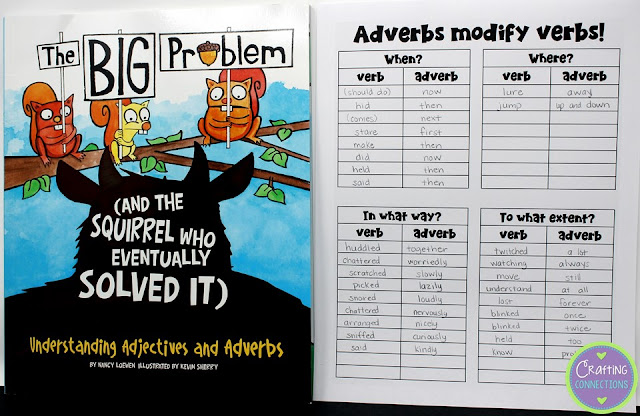
The book I found is called The Big Problem (and the Squirrel Who Eventually Solved It): Understanding Adjectives and Adverbs by Nancy Loewen.
Use this read aloud to teach your students about adverbs and how they are used in sentences! This blog post contains an adverbs lesson idea and free printables!

It is somewhat hard to see in these photographs, but the author used a red font on every single adjective in the book, and a green font for each adverb.
Use this read aloud to teach your students about adverbs and how they are used in sentences! This blog post contains an adverbs lesson idea and free printables!

Use this read aloud to teach your students about adverbs and how they are used in sentences! This blog post contains an adverbs lesson idea and free printables!


HOW I INTEND TO USE THE BOOK IN A GRAMMAR LESSON!

This book presents the perfect opportunity to help students understand why an adverb is an adverb. The adverbs are already identified, leaving plenty of time to analyze each sentence and determine which word is being modified by each adverb, and how it is modifying the other word.

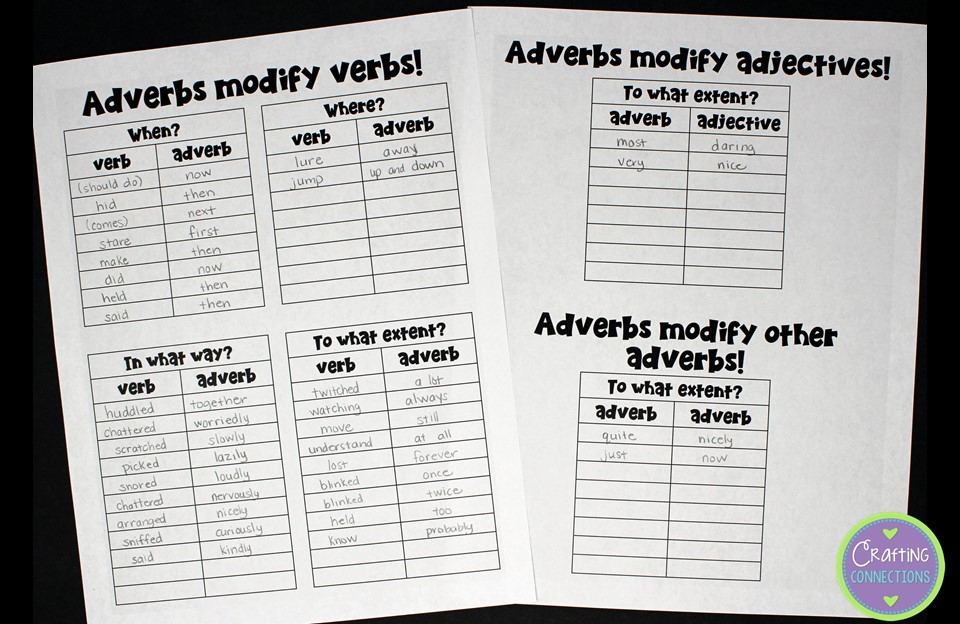
I recommend printing the two printables (shown below) back-to-back, so that it's on one sheet of paper, and then handing out a sheet to each student. 
Adverbs recording charts! Use these charts along with a read aloud book with plenty of adverbs.

I intend to use the document camera to project the book so that every student can read the pages along with me (silently) as I read them aloud. At the end of each page, identify the adverbs, one at a time, and have your students name the chart to which the adverb belongs. To do this, they must identify which word is being modified by the given adverb, and whether that word is a verb, adjective, or other adverb. If the word is a verb, they must also determine how that adverb is modifying the given verb. 

When you have finished the book, your  students' papers should look like this: 
Use this read aloud to teach your students about adverbs and how they are used in sentences! This blog post contains an adverbs lesson idea and free printables!

Teach your students about adverbs and how they are used in sentences by reading the book The Big Problem by Nancy Loewen. This blog post contains an adverbs lesson idea and free printables!
One of the things I love about this book and activity is that it shows that many adverbs do not end in -ly! Also, students are required to truly analyze the use of each adverb in the sentence! Furthermore, this book can also be used to identify adjectives... but that's another blog post! :)

If you happen to be looking for a few more ready-to-go adverb resources to use in your classroom, feel free to check out my TpT store. The image below shows the materials I created for teaching students about adverbs. If you click on the image, you'll be taken to the bundle in my store. From there, you can also check out each individual adverb resource, as well.


Have a great day!


Pin for later:
Use this read aloud to teach your students about adverbs and how they are used in sentences! This blog post contains an adverbs lesson idea and free printables!

Context Clues: Read Alouds with FREE Printables!

Thursday, September 14, 2017
As a teacher of English Language Learners, I always spend quite a bit of time each year focusing on context clues. I feel that it's essential to teach students how to use clues within the sentence and in surrounding sentences to "crack" the meaning of an unknown word. I use a detective theme, and students always respond well to this analogy. They enjoy "putting on their detective hats" and "solving the mystery" regarding an unknown word. 

Today, I decided to share two published books that I like to use as mentor texts when I am teaching about context clues. One is perfect to use with students in the younger grades (2nd-3rd), and the other is better suited for students in 4th, 5th, and 6th grade classrooms. (Full disclosure: this blog post contains affiliate links.)
FREE Context Clues Lessons! These two books are perfect for practicing how to use context clues when reading!  There is a free worksheet with each book!

Context Clues Mentor Text: Middle Elementary

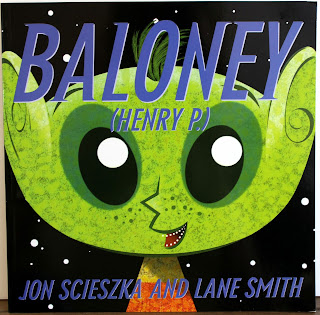
The picture book Baloney (Henry P.) by Jon Scieszka is perfect for students in 2nd and 3rd grade classrooms. In this book, the main character is an extraterrestrial named Henry P. Baloney. He is late for school and has to scramble to come up with an excuse for his teacher. 
FREE Context Clues Lessons! This book is perfect for practicing how to use context clues when reading!  A free worksheet is available, too!

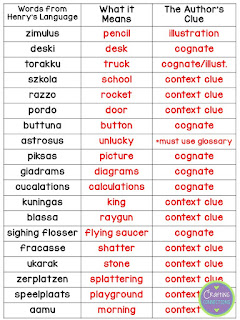
What makes this book so fun, though, is that Henry uses his own language as he makes up an outlandish excuse for his teacher. In creating Henry's language, Jon Scieszka uses words from 17 languages on Earth (plus a spoonerism and a couple transpositions). The result is sentences like "...which made me exactly seven minutes late this aamu."
FREE Context Clues Lessons! This book is perfect for practicing how to use context clues when reading!  A free worksheet is available, too!

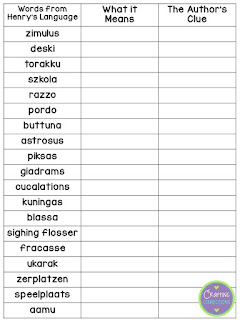
When I read this book with students, I like to have them try to use context clues to determine the meaning of each foreign word. When I turn to a new page, I do not show them the illustrations right away. First, I read the page, and then ask the students if they can figure out what each unknown word means. Sometimes, it is impossible to decipher the meaning of the unknown words without looking at the illustrations (zimulus on the page above provides an example of this). Other times, the word is a cognate (like deski), making it easy to predict. Finally, there are words where students can use context clues found in the rest of the sentence or surrounding sentences (like torakku and szkola) to determine the word's meaning.

I created this handout to use with this book. I place it below my document camera, and we record our thoughts as we progress through the book. 
FREE Context Clues Lessons! The book Baloney is perfect for practicing how to use context clues when reading!  Use this free worksheet along with the book!   FREE Context Clues Lessons! The book Baloney is perfect for practicing how to use context clues when reading!  Use this free worksheet along with the book!

Note: The image on the right shows the answer key. Keep in mind, though, that the last column may vary, based on your discussion with your students. For example, the word fracasse requires some deep thinking, and will likely be difficult for your students to figure out on their own. You might decide to go directly to the glossary to find the definition for this word. Personally, I would try to help guide my students through the clues given by the author. (For example, you might remind them that at this point in the book, the astro guys are furious with Henry because he just insulted them and destroyed their raygun. The author says that the astro guys made a new plan to fracasse Henry's school. What might they want to do to Henry's school if they are angry?)


Context Clues Mentor Text: Upper Elementary

The chapter book The Get Rich Quick Club by Dan Gutman lends itself to creating a fun context clues lesson for students in 4th, 5th, and 6th grades. In this book, one of the supporting characters, Quincy, is from Australia. She uses Australian slang phrases often, and it's super fun to try to use context clues to decipher what she's actually saying! 
FREE Context Clues Lessons! This book is perfect for practicing how to use context clues when reading!  A free worksheet is available, too!

As you can see below, Dan Gutman provides translations in the form of footnotes at the bottom of each page.
FREE Context Clues Lessons! This book is perfect for practicing how to use context clues when reading!  A free worksheet is available, too!

I created the handout below to use with Chapter 2 of this book. I begin the lesson by telling students that we have an unusual, yet fun way to practice using context clues today! It involves reading a few chapters from this book. I explain that I will read a few pages aloud before starting the context clues activity. Then, I open up the book and start reading from the beginning of the book. (You'll likely succeed in enticing a few of your students to read the entire book on their own!) However, if you're running short on time, you can start at page 7, where Chapter 2 begins. When you reach page 11, distribute the handout. Tell your students that the rest of the pages in this chapter have similar phrases said by Quincy, and you will be stopping at the end of each page to give them time to use context clues, and then record their predicted translations on the lines. I suggest doing the first one together as a class.
FREE Context Clues Lessons! The book The Get Rich Quick Club is perfect for upper elementary students who are reviewing context clues! Use this free worksheet along with the book!      


I hope you and your students enjoy these two mentor text lessons! If you're looking for additional context clues activities, be sure to check out this blog post, where I share a free interactive lesson! Also, feel free to take a look at the resources I have available in my TpT store. I've displayed images of my two bundles below, but all of these activities are available for individual purchase as well.


A Context Clues Bundle designed especially for students in 
2nd and 3rd grade:

A Context Clues Bundle designed especially for students in 
4th, 5th, and 6th grade:


Funny, New Picture Books Your Students Will LOVE!

Saturday, May 20, 2017

Elementary students of all ages will enjoy these hilarious new picture books!
For me, stepping into the children's section of my local bookstore, and gazing at the covers of the featured picture books is like walking into a bakery and ogling over the decadent treats that line the bakery case. In both locations, my heart starts to race and my mouth begins to water! Can you relate?

During my most recent trip to the bookstore, I hit the jackpot! I found two books that were completely new to me (published in 2017), and I fell in love with both of them. Both are quite funny, making them perfect books to engage students of all age levels. (Full disclosure: This blog post contains affiliate links.)

The Legend of Rock Paper Scissors

The Legend of Rock Paper Scissors by Drew Daywalt- This hilarious picture book will surely become a favorite classroom read-aloud!
As you can probably guess, The Legend of Rock Paper Scissors was the first book to catch my attention. Check out that cover! I was eager to open it up and find out how Drew Daywalt created a legend to go along with this popular game.
The Legend of Rock Paper Scissors by Drew Daywalt- This hilarious picture book will surely become a favorite classroom read-aloud!

The Legend of Rock Paper Scissors by Drew Daywalt- This hilarious picture book will surely become a favorite classroom read-aloud!

I was not disappointed. This book is hilarious! It begins with Rock's crushing defeats over Clothespin and Peach. Next, it moves on to Paper's victories over Printer and Trail Mix. Then, readers watch Scissors defeat Tape and Chicken Nuggets. Finally, the epic battles between Rock, Paper, and Scissors take place. The three great warriors are relieved to finally have met their matches. The story ends with "That is why children around the world- in backyards, on playground, and yes, even in classrooms- still honor the three great warriors by playing... Rock, Paper, Scissors!"

The Legend of Rock Paper Scissors by Drew Daywalt- This hilarious picture book will surely become a favorite classroom read-aloud!

The author does an exceptional job of exhibiting voice in this book. In fact, if you teach your students about the Six Traits of writing, and spend time on the voice trait, this would be a great mentor text to add to your list.

I highly recommend asking your librarian to consider purchasing this book for your school library, or you might even want to purchase a personal copy for your own classroom. (Kids will be waiting in line to check this out from the library!) This one is sure to become a class favorite! I must warn you, there ARE a few incidents of some crude humor, so if this makes you uncomfortable, you might not enjoy this book quite as much. (Clothespin is holding a pair of men's underwear when they do battle. Also, when Rock challenges Peach, he tells Peach, "You, Sir, look like a fuzzy little butt.") I'm sure the crude humor, though, will make students love this book even more!

XO, Ox: A Love Story

XO, OX: A Love Story by Adam Rex! This fun classroom read-aloud is perfect for identifying character traits, theme, and to practice inferencing!
This book is quite different than The Legend of Rock Paper Scissors. Whereas the previous book was clearly funny in an in-your-face sort of way, XO, Ox: A Love Story contains more subtle humor. I love reading these sorts of picture books with upper elementary students because it's so fun to watch them "catch" the more advanced humorous elements.

In this book, Ox writes a fan letter to Gazelle to tell her that he loves her. Gazelle send a canned response and a photo as a reply. Ox, which turns out to be quite gullible, write a second letter and receives the same reply. Ox does not understand that Gazelle is not responding herself, in fact, he writes back and mentions the "amazing coincidence!" The book continues on with Ox and Gazelle exchanging letters, and Gazelle gets more and more rude in her responses to Ox.
XO, OX: A Love Story by Adam Rex! This fun classroom read-aloud is perfect for identifying character traits, theme, and to practice inferencing!

One of the best things about this book is its ending. It ends with "Dear Ox," and the reader must infer what Gazelle is going to tell Ox in her letter. The illustrations on the final page and inside the back cover makes the ending obvious.
XO, OX: A Love Story by Adam Rex! This fun classroom read-aloud is perfect for identifying character traits, theme, and to practice inferencing!

This book also includes an important message about judging others. This book would make a great read-aloud while you are covering ELA topics like character traits, inferencing, and theme.

I would love to hear your humorous picture book recommendations! Please comment below with a favorite title that I should check out!

Pin for later:


Read Alouds for Black History Month (with free printables!)

Friday, January 27, 2017
In the United States, February is Black History Month. This month is dedicated to educating Americans about the countless contributions African Americans have made to our country, as well as remembering the obstacles they've had to overcome throughout American history.

My favorite way to celebrate Black History Month in the classroom is to present read alouds. There are so many excellent picture books that would be perfect to read during February... I'm going to share two with you today. (This blog post contains Amazon affiliate links.)

Two incredible books that highlight important aspects of African American history. This blog post also contains a FREE printable that can be used as a follow-up activity for each book! Great for Black History Month or for any time of the year!


SIT-IN: HOW FOUR FRIENDS STOOD UP BY SITTING DOWN

A fabulous book about a student-led protest that took place during the Civil Rights Movement. This blog post contains a FREE follow-up writing activity, too!

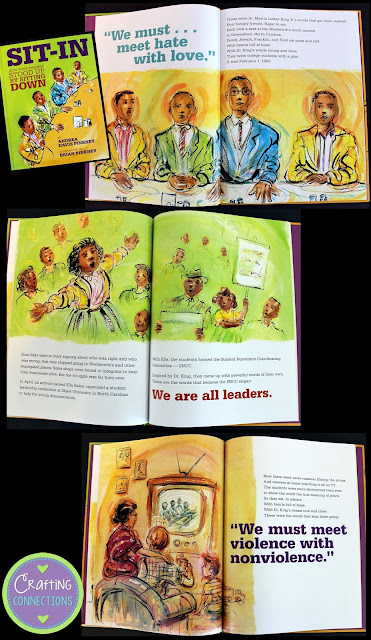
Sit-In: How Four Friends Stood Up by Sitting Down is written by Andrea Davis Pinkney, and is illustrated by her husband, Brian Pinkney. It tells the story of the four young college students who, after hearing Dr. King's messsage, took a seat at the Woolworth's lunch counter in Greensboro, North Carolina. They ignored the restaurants segregation policy, and refused to leave until they were served. The book goes on to explain how word of the sit-in spread like wildfire, and soon there were sit-in protests happening across the country during 1960.

The author of this book uses a beautiful poetic voice. I like how some of the most important messages of the Civil Rights Movements are written in bold to really stand out.
Sit-In is a fabulous book about a key student-led protest that took place during the Civil Rights Movement. This blog post contains a FREE follow-up writing activity, too!

I created a simple follow-up writing activity that highlights a few of those quotes that are written in bold. Click HERE to download the writing worksheet.

Sit-In is a fabulous book about a key student-led protest that took place during the Civil Rights Movement. This blog post contains a FREE follow-up writing activity, too!


Also, I found this 4-minute video clip that summarizes how non-violence was key to the Civil Rights Movement. I suggest showing this video before reading the book to provide background knowledge.
Cut and paste this link to access a sharp image: http://www.voanews.com/a/nonviolencekey-to-civil-rights-movement/1737280.html

THE SECRET TO FREEDOM

This is a fabulous book that tells about how quilts were used to guide escaped slaves along the Underground Railroad. What a great read-aloud for Black History Month or any time of the year! This blog post contains a FREE test prep activity that accompanies this book.

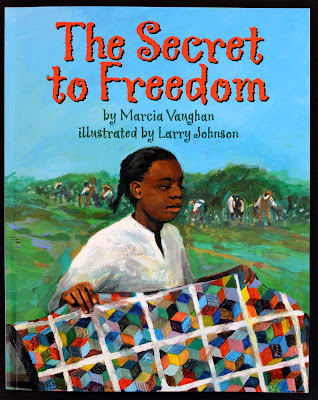
The Secret to Freedom is by Marcia Vaughan. Although it is historical fiction, it is written like a personal narrative. The book is written in first-person as the narrator recalls visiting her great-aunt Lucy when she was 10 years old. The young girl asks her great-aunt Lucy about the quilt scrap hanging from the kitchen wall. That's when Great-aunt Lucy tells her story of growing up as a slave on a plantation in South Carolina right before the Civil War.

It's a heart-wrenching story, as she tells of how Lucy's parents were sold to a far-away plantation, and how her brother is tied to a tree and whipped for no good reason. It's also an inspiring story, however, as Lucy tells of how Albert arrives home one day with a sack of quilts. The quilts are sewn in such a way that they contain a secret code, as each pattern gives important information to slaves planning to escape along the Underground Railroad. Lucy hangs certain quilts on certain days, and the plantation owners have no idea what is happening on their property.

The ending of this story is very touching, and it reinforces the unyielding strength of family bonds. In fact, if I were reading this book to upper elementary students, I would definitely take a moment to determine the theme of the book after finishing the story.

I truly love the book itself, so when I found the Author's Note, it was an added bonus! The author's note gives additional details about how the quilts were used to convey messages to the passengers of the Underground Railroad.
The Secret to Freedom is a fabulous book that tells about how quilts were used to guide escaped slaves along the Underground Railroad. What a great read-aloud for Black History Month or any time of the year! This blog post contains a FREE test prep activity that accompanies the Author's Note at the end of the book.

The Secret to Freedom is a fabulous book that tells about how quilts were used to guide escaped slaves along the Underground Railroad. What a great read-aloud for Black History Month or any time of the year! This blog post contains a FREE test prep activity that accompanies the Author's Note at the end of the book.
The back cover provides illustrations that match the quilt patterns described in the Author's Note.


USING THIS BOOK AS A TEST PREP ACTIVITY

This blog post contains a test prep activity that can be used with the read-aloud book The Secret to Freedom. Use the author's note to model an excellent test-taking strategy!

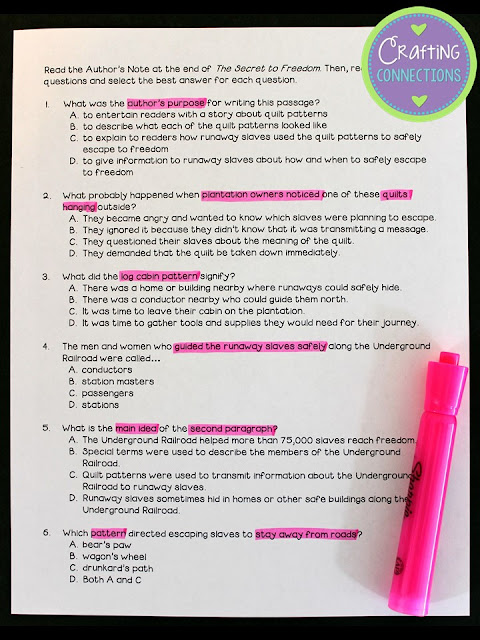
In the school districts near me, teachers are preparing to take standardized test in late February or in March. When I read the author's note, I decided that it would provide a perfect ELA test-prep activity in which a teacher could model the best way to approach a reading passage on a test.

In the school district where I most recently taught, we instructed students that a good test taking strategy is to read the question stems first, highlighting the important words in the stem. This allows students to "read with purpose" because they know what information they should be looking for as they read. After reading through the question stems and determining the important words, our paper looks like this:

FREE TEST PREP PRINTABLE! This blog post contains a test prep activity that can be used with the read-aloud book The Secret to Freedom. Use the author's note to model an excellent test-taking strategy!
Click on this image to download this free test prep printable!


The next step is reading the passage, of course. For this modeling activity, I would think-aloud as I read aloud. For example, when I reached the section about the log cabin, I would say something like "Hey! I remember highlighting "log cabin" when I was reading the question stems. I'm going to highlight it here on the passage so I can refer to it easily when I am answering the questions.

After reading the entire passage, I would return to the questions and answer each one. I would also model how I would return to the text to justify each of my answers.

Would you like an opportunity to win these two books? Just enter the Rafflecopter! I will ship the book to the winner of each giveaway!


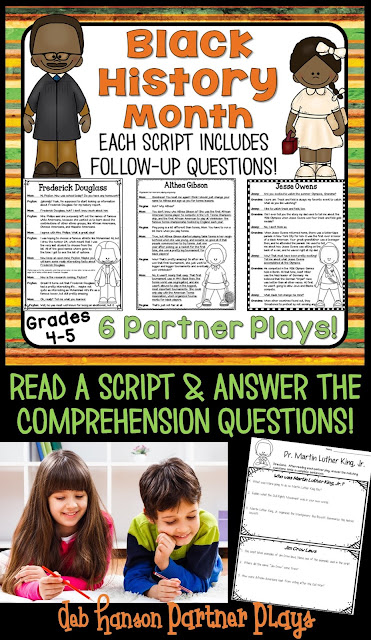
Finally, if you are looking for additional activities to recognize and celebrate Black History Month in your classroom, feel free to check out my partner plays! This set includes SIX scripts featuring the accomplishments of Frederick Douglass, Hank Aaron, Elijah McCoy, Ruby Bridges, Thurgood Marshall, Althea Gibson, and Jesse Owens. Click on the image to check them out!
Black History Month Partner Plays for upper elementary classrooms! Great for building fluency and recognizing the contributions of African Americans throughout history!


Powered by Blogger.
Back to Top