Crafting Connections: Craftivities
Showing posts with label Craftivities. Show all posts

Reference Materials... A FREEBIE!

Wednesday, December 21, 2016
I've been knee-deep in creating some reference material resources lately, so I decided to create some items to share with my blog followers!

If you've read my blog for a while, you know that I'm an anchor chart fanatic, so of course I couldn't pass up the opportunity to create a Reference Materials anchor chart!

This anchor chart is set up the same as the graphic organizer that's included in my free craftivity.

I envision doing the craftivity as a culminating project to conclude a study of reference materials. Each student chooses his or her own topic. After students choose a topic that interests them, they consider how they might use each type of reference book to research for a project, and/or write a report about their chosen topic. They jot down their ideas on the brainstorming paper. The photo below shows some completed papers.

When students finish brainstorming, they color and cut out the reference material images. They also write their chosen topic on their title box, and cut that out, as well.
Reference Materials Craftivity... FREE! Students explain how they would use a dictionary, thesaursus, atlas, almanac, and encyclopedia to research for/write a report on the topic of their choice!Reference Materials Craftivity... FREE! Students explain how they would use a dictionary, thesaursus, atlas, almanac, and encyclopedia to research for/write a report on the topic of their choice!

Finally, each student assembles his or her craftivity on a sheet of construction paper. 
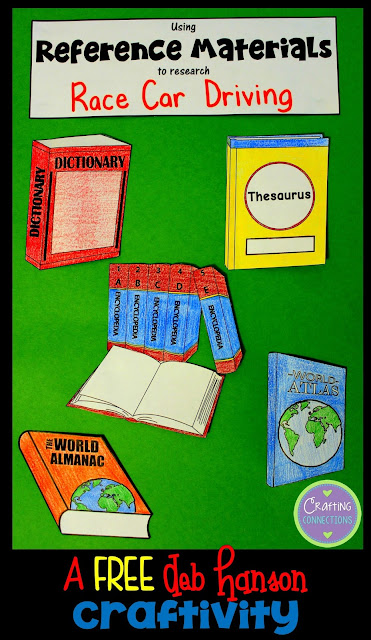
Reference Materials Craftivity... FREE! Students explain how they would use a dictionary, thesaursus, atlas, almanac, and encyclopedia to research for/write a report on the topic of their choice!
Click on this image to download this free craftivity!
When students glue their books onto their sheet of construction paper, they only draw a light line of glue along the spine of the book. Then, when they place it on the construction paper, it creates a flap. After allowing the glue to dry for a few minutes, students gently pull back the flap and write a complete sentence on the construction paper explaining how they would use each individual reference book to research for a project or write a report on the topic listed in the title box!
Reference Materials Craftivity... FREE! Students explain how they would use a dictionary, thesaursus, atlas, almanac, and encyclopedia to research for/write a report on the topic of their choice!

My favorite thing about this particular craftivity is that each student creates a completely unique project in the end! Therefore, I think they could be used to create a great bulletin board or hallway display!

As I mentioned earlier, I envision this being a culminating project for the end of a reference materials study. If you are interested in checking out any of the other materials I created to introduce reference materials to my students, just click on the images below!

eference Materials PowerPoint- 112-slide PowerPoint that covers the dictionary (along with guide words), thesaurus, encyclopedia, atlas, and almanac.


Reference Materials Task Cards! These 24 task cards cover the dictionary (along with guide words), thesaurus, encyclopedia, atlas, and almanac.

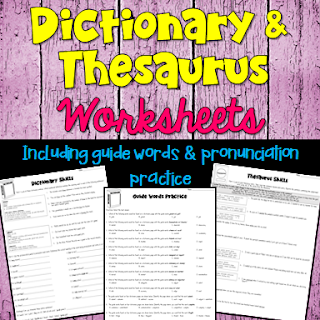
Dictionary and Thesaurus Worksheets! Includes guide words, pronunciation keys, and use entries from both reference books correctly.

Parts of Speech Craftivity... for FREE!!

Friday, August 7, 2015
I am just writing a super-short blog post today to share my revised FREE Adjective & Adverb craftivity!  In my experiences teaching upper elementary, students struggle with adjectives and adverbs... and understandably so.  They do have similar functions.  Students must have a solid understanding of nouns and verbs before they are able to reliably identify adjectives and adverbs.  Most of the time, students do fairly well identifying adjectives and adverbs in isolation (for example, many kids understand that "beautiful" is an adjective), but once you ask them to identify the part of speech of a certain word in a sentence, it suddenly becomes much more difficult for them!

And that's why I decided to create this FREE craftivity!  It gave my students another opportunity to identify adjectives and adverbs in sentences, yet it wasn't a "boring, old worksheet".  Plus, it makes a great fall wall display!  If you think you can use it with your students this year, please feel free to click on the photo and download it!
Check out this FREE Parts of Speech Craftivity!  Students identify whether the underlined word within each sentence is an adjective or an adverb, and then assemble the craftivity!


If you want to know more about the benefits of using craftivities in your classroom, check out either or both of the following blog posts:

Using Elements of Craftivities in Interactive Notebooks (this post contains another freebie!)

Using Elements of Craftivities in Interactive Notebooks!

Sunday, January 4, 2015

Hello Friends!

It was my turn to write a post at Upper Elementary Snapshots today!  Hop over there to read my post!

Reasons to Use Craftivities

For those of you who might be new to my Crafting Connections blog, welcome!  If you click on the "FREEBIES" tab at the top of my blog, you will see another craftivity that I give away free to my blog followers!

In addition to the five I shared at Upper Elementary Snapshots, I want to share one final reason why I love to use craftivities in the classroom... elements of craftivities are ideal additions to interactive notebooks, and provide students with one more device that will hopefully aid in their long-term retention of a skill or concept!


I have students glue pieces of craftivities into their interactive notebooks to further "cement" the connection.  For example, when our focus concept was “inference”, I had students create the “Let’s Make S’more Inferences” craftivity.

Using Elements of Craftivities in Interactive Notebooks


I made an extra set of photocopied s'more elements for each student (shown below), and instructed them to write a description/definition for text clues, background knowledge, and inferences inside the appropriate items.

Using Elements of Craftivities in Interactive Notebooks

They glued these pieces on the left side of their interactive notebook page.  Then, rather than gluing all six s’mores on the craftivity project, I instructed them to save one and glue it to the right side of their interactive notebook.

Inferences
The left side of the notebook shows definitions/descriptions of the S'more analogy.
The right side shows an inference s'more that the students completed after reading a short passage.  They wrote the text clues provided in the passage on the bottom graham cracker, their background knowledge on the top graham cracker, and their inferences on the chocolate bar and the marshmallow.

I have a few "craftivity companions" all ready ready to go for you!  Click on any of the images below to download it for free!

Prefixes FREEBIE! Students write the meaning of various prefixes and provide example words for each prefix. This interactive notebook freebie can be used with any set of prefixes!

FREE Main Idea Activity! Students can glue this visual in an interactive notebook and refer to it as needed.

Teach your students how to recognize different types of context clues with this interactive notebook activity! It's FREE!

FREEBIE for teaching about themes in literature! Students can glue this foldable into interactive notebooks and refer to it as needed!


Adjectives Anchor Chart

Monday, December 8, 2014
My anchor chart today focuses on adjectives. This all came about as a result of a conversation that took place around our family dinner table last Tuesday evening.  It went like this:


Kayla (my fourth grader):  We are learning about adjectives in school this week.

Me:  So tell me what an adjective is.

Kayla:  (long pause)  A person, place or thing???

Brooke (my second grader):  No, that's a noun.  And I know that a verb is an action word.

Me:  Kayla, you learned about adjectives way back in second grade.  You remember what they are, don't you?

Kayla:  Hmmm... I can't remember...adjectives are hard!

Me:  An adjective is a describing word, it describes a noun...


Parts of speech.. so difficult for so many kids! As a teacher who has worked with all elementary grade levels, I know that most kids have trouble retaining what they learn about parts of speech. Fourth and fifth grade teachers, don't you find that you always have to start over and review (a lot) all parts of speech before you can get to the new ones introduced at your grade level?? I can tell you that there was a point when Kayla was in second grade and in third grade when she could tell you exactly what an adjective was, and identify an adjective in a sentence! But... time passed and she obviously forgot what she learned!

So... I spent a lot of time thinking about this issue this week, trying to think of a clever connection that would help students recall what an adjective does in a sentence.  Here's what I came up with:

Adjectives Anchor Chart- Adjectives are like magnets... they are attracted to nouns (and pronouns)!
Clip art by Educasong.
When I teach this lesson in a classroom, I plan to create the above anchor chart prior to the beginning of class.  I will tape it to the board, and then tape up the bottom so that only the question is displayed at the beginning of the lesson.  I think it would be interesting to have students answer this question themselves. They may come up with some connections that I hadn't considered!
Adjectives Anchor Chart- Adjectives are like magnets... they are attracted to nouns (and pronouns)!

After a brief brainstorming session, I would remove the tape from the anchor chart and reveal the rest of the information, and discuss the connection that I came up with.

Then, I would have students help me find the adjectives and the nouns/pronouns they are attracted to in the example sentences on the chart.  

Adjectives Anchor Chart- Adjectives are like magnets... they are attracted to nouns (and pronouns)!

Now is a time when I wish I had a classroom so that I could teach this lesson and find out if the connection will be meaningful for students, and help them with long-term retention. What do you think? Will the mental connection of an adjective being comparable to a magnet work? If any of you try this approach with your students, please let me know how it goes!  

In fact, I created a matching craftivity!  If you don't want to recreate the anchor chart, you can use the teaching poster that I created for the craftivity file.

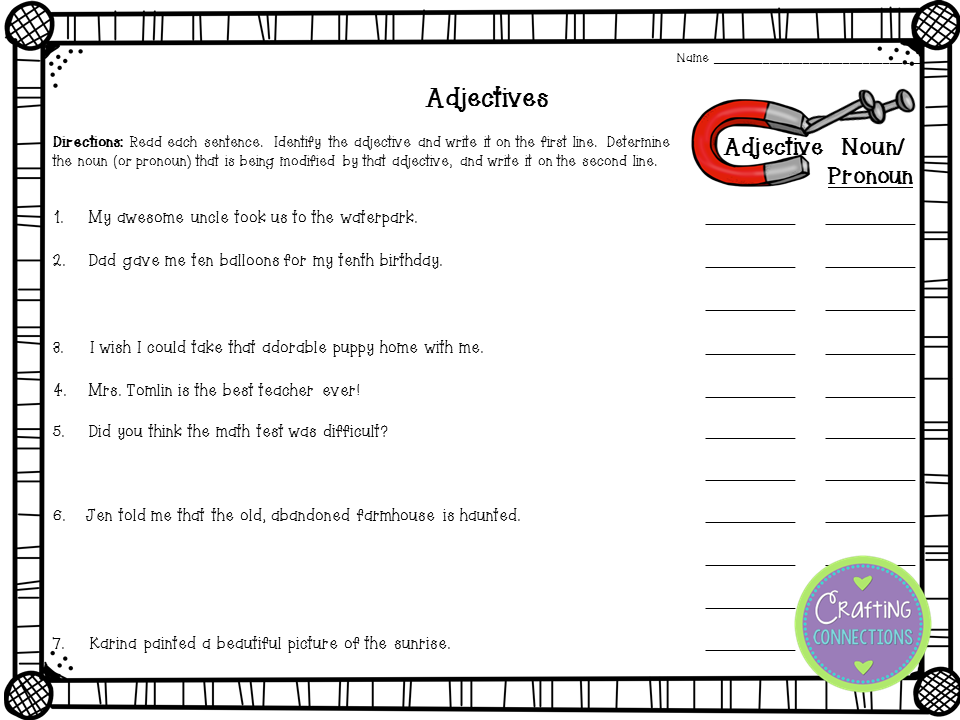
Adjectives Craftivity- includes worksheets and a teaching poster! How are adjectives like magnets? Adjectives are attracted to nouns!


Adjectives Craftivity- includes worksheets and a teaching poster! How are adjectives like magnets? Adjectives are attracted to nouns!
Students complete the above worksheet (the file includes another worksheet page, too), and then use their answers to assemble the craftivity.


Adjective Craftivity: Adjectives are like magnets- they are attracted to nouns! This resource includes a poster and a 2-page worksheet.

Thanks for dropping by today!


Save for future reference:
How are adjectives like magnets? This is an analogy that you'll want to use with your students! Check out the matching adjectives anchor chart in this blog post, too!

Synonyms & Antonyms Anchor Chart... with a freebie!

Monday, August 25, 2014
Today's anchor chart focuses on synonyms and antonyms
Synonyms and Antonyms Anchor Chart
As an ELL teacher for grades 3-5, I created this anchor chart as part of a third grade lesson. However, I observed my fourth and fifth grade students referring to it regularly, as well. This seems to be a concept that some students understand immediately, and others struggle to grasp.

When I introduce this anchor chart, it looks like this before the lesson:
Synonyms and Antonyms Anchor Chart- create the rest of the chart with your students!

We start with the Synonym side of the anchor chart, and I point all of the mnemonic devices I tried to include- that "Synonyms" and "Same" are both colored the same color and they both begin with 'S', and that if you remember that all cinnamon rolls look nearly the same, it will help you remember that synonyms are words that mean nearly the same thing. Then, I have students help me decide what words we should write to create the synonym pair.  They quickly discover that most words have more than one synonym (pretty, lovely, beautiful), but I only write one of their suggestions on the chart so that it does not become too overwhelming.

Next, we move on to the antonym side of the Anchor chart, and I point out the various mnemonic devices I devised for this side- that "Antonyms" and "Opposite" are written in different colors, that the different colored ants are moving in opposite directions, etc.  When we get to the word "older", they realize that "newer" is an antonym, but "younger" can be an antonym, as well! When this happens, I quickly point out that we need to look at the context of the sentence, and write some example sentences on the board:
My older brother is twelve years old, while my ______ brother is two years old.
I have an older copy of the book. I think yours is a ________ edition.

After the anchor chart has been completed, I have students make a matching interactive notebook entry. Students match their interactive notebook page to the anchor chart by using only blue for the synonym page, and alternating green and red for the antonym page:
FREE Synonyms and Antonyms Interactive Notebook Entry! This blog post contains the materials to make a matching synonyms and antonyms anchor chart, as well!

You can download the materials to make the anchor chart AND the interactive notebook entry for FREE by clicking on the image above:


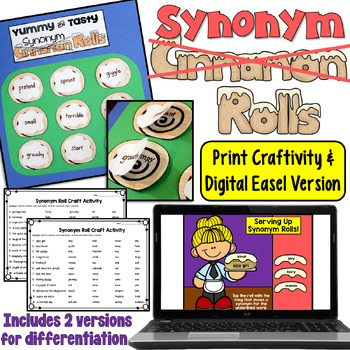
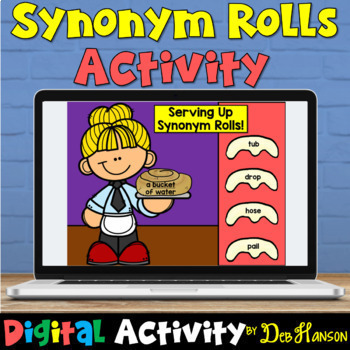
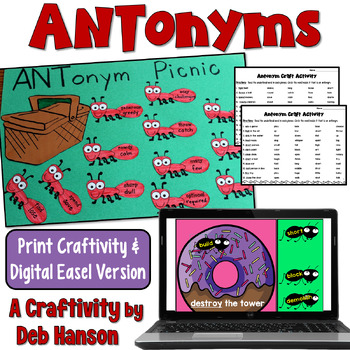
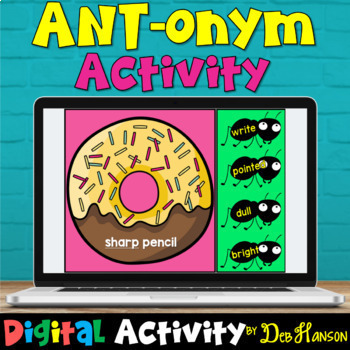
Feel free to check out my matching activities. As you can see, I have created printable versions and digital versions of these activities. Click on an image to take a closer look at it!

Synonym Rolls CraftivityCheck out this digital version of my synonym craftivity!


Keep your students engaged with this antonym craftivity!  Check out this digital version of my antonym craftivity!

Thanks for stopping by!

~Deb

Teaching about Themes... using the cupcake analogy!

Monday, July 28, 2014
This blog post uses the cupcake analogy to define and explain story themes. Just as creme can be hidden inside the cupcake, the theme is hidden inside a story. This blog post includes free posters, too!

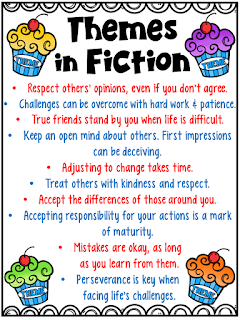
This anchor chart explains the cupcake analogy that I share with my students when I am teaching them about themes in literature.
Theme anchor chart- Use this to remind students how book themes are like filled cupcakes. (Includes TWO FREEBIES!)

This all started a few years ago, when my upper elementary students were struggling with the concept of "theme". Many of them were confusing "theme" with "main idea", even after all of our practice activities. I needed to try something different... something that would be catchy enough to stick with my fourth and fifth graders. I'm not sure how I came up with theme-filled cupcakes. I suppose I was rhyming words in my head, and realized "cream" rhymes with "theme". Anyway, when "theme-filled cupcakes" crossed my mind, I knew I was on to something.  After all, the theme of a book is usually hidden, just like the creme inside a cupcake. Theme is the central message of a book, just as creme is central to the cupcake.

If you have followed me for awhile, you already know that I have a sweet tooth and that I love food analogies. Also, I often design my anchor charts to match other activities I do with my students.  (I believe this helps students build connections and retain the huge amount of new learning they encounter each day!)

Click on any of the images below to download my freebies related to teaching about themes in literature!
FREE Themes in Reading Posters!   FREE Themes in Reading Posters!       

Notice that the word "selfishness" is underlined on the first poster. I point out to my students that any number of negative traits can be written in place of "selfishness". Therefore, these are a few more theme possibilities:
  • Dishonesty can lead to negative consequences.
  • Laziness can lead to negative consequences.
  • Rude behavior can lead to negative consequences.
FREEBIE for teaching about themes in literature! Students can glue this foldable into interactive notebooks and refer to it as needed!

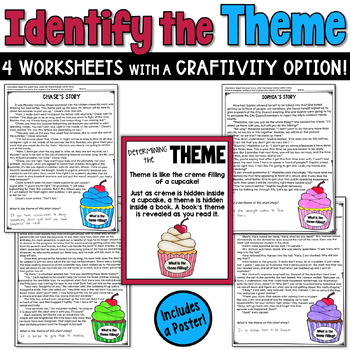
If you would like to take a look at the theme resources available in my store, click HERE. My theme filled cupcake craftivity is one of my favorite activities of the year!

This theme activity was created to help students truly understand the meaning of themes in literature. (A theme is hidden in a book just like creme can be hidden inside a cupcake!) Four passages are included. Students lift the flap to reveal the theme of each passage!


Thank you for stopping by!

~Deb

Subjects & Predicates Anchor Chart

Monday, July 14, 2014
Last fall, the third grade teacher team that I co-taught with was on a mission.  We decided that we needed to do something about the frustrating fragments that often plagued our third graders' writing.  Therefore, we started the school year by teaching the four types of sentences during writing time.  Immediately after that, we tackled subjects & predicates.  

We wanted to provide meaningful experiences that would engage third grade students... a somewhat daunting goal at times when grammar is the task at hand.  We sat there, puzzled, for several minutes. 

Slowly, my ideas started chugging. When brainstorming, I often try to come up with some sort of visual that students can apply to a new concept. Thinking while I spoke, I suggested that we try using a train analogy to teach subjects and predicates this year.  We could teach students to think of a complete sentence as a train, with the subject being the train's engine, and the predicate serving as the train's caboose.

Subject and Predicate Anchor Chart- using the train analogy!

Then, in true Deb fashion, I started to envision a craftivity.... and then a PowerPoint... and then a page for their interactive notebooks... and within a matter of minutes, I had volunteered to create a series of train-themed subject and predicate materials.  One of the things I loved about working with the third grade team at my school was that even when they didn't quite "see" the vision that I tried to explain to them, they always supported my elaborate visions and let me run with my ideas and create!

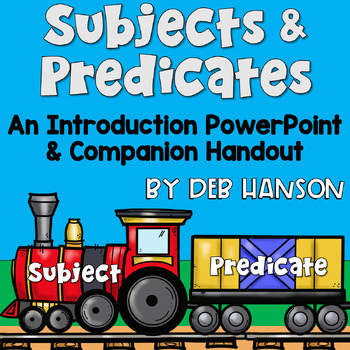
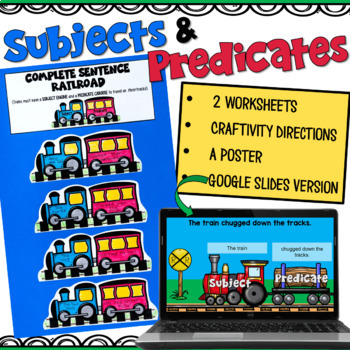
Subject and Predicate PowerPoint! Use a train engine and a caboose to help your students understand the concept of subjects and predicates!
This interactive PowerPoint contains 30 slides. After the introductory slides, students are given the opportunity to identify the subject and predicate within 15 practice sentences. 


Subject and Predicate Craftivity! Use a train engine and a caboose to help your students understand the concept of subjects and predicates!

Not only did our third graders really seemed to enjoy the subject & predicate activities we did last year, I can honestly say that they really seemed to latch onto the train analogy!  As teachers, we were very pleased with their progress following this unit.  Best of all, it seemed to make a difference!  Although we still had students who occasionally used fragments, these incomplete sentences didn't seem to plague the students' writing to the extent they had in years past. Furthermore, once we brought the fragment to their attention, students understood how to fix the problem almost immediately!  
  
Thanks for stopping by!

~Deb

Main Idea Cones with Delicious Detail Scoops!

Thursday, July 18, 2013
It's July...who doesn't have an ice cream cone on their mind nearly every evening?  I must admit, I'm a soft-serve fan... the more swirls of soft, creamy vanilla goodness topping a flaky cone the better!  And I have to ask - does anyone else absolutely relish that last bite of the cone, once it's gotten all soggy and mushy?  I pop it into my mouth and savor as it melts on my tongue.  Okay, so I totally digress...

Anyway, July...Summer...ice cream...all make me feel like this is the perfect time to feature my second best-seller at my store - my Main Idea Ice Cream Cones craftivity!


Click HERE to purchase!
I have to say, when I did this craftivity with my fifth graders, they had a ball with it!  I saw some very creative cones!  I had birthday cake flavored scoops, candy bar scoops, fruit-filled scoops, you name it! 
A close up look at some creative scoops!
Here's "the scoop" on how this craftivity works.  Six cones contain a "main idea" sentence.  Nine scoops contain a sentence that is a supporting detail to one of the six main idea sentences.  Students must find the three supporting detail scoops that match each main idea sentence.  Once the have done this, they glue the scoops onto the cones and decorate their cones to their heart's desire.

Some teachers reported having this as a center activity, while others did it as a whole group activity.  A good number of teachers have provided feedback that this activity really helped students grasp the concept of main idea and how supporting details help to "hone in on" the main idea.  

Now I'm off to the freezer... 


Adjectives, Adverbs... and Apples!

Thursday, July 11, 2013
It only seems appropriate to have my first featured craftivity to be filled with the first letter of the alphabet! (Hmmm...maybe I should make my way through the alphabet with future craftivities...On second thought, maybe not. That seems like way too much work for no good reason!)


I think this craftivity would make a great review to do with upper elementary students at the beginning of the school year. In fact, I'd probably tell them this activity is meant to help them clear those cobwebs from the learning room of their brain that was enjoying a nice, long break over the summer, but now needs to be cleared for more learning with you this year!  :) Besides that, apples are in season during the fall...who doesn't love a shiny, crunchy apple on a September or October day? (Okay, I have to admit that I'd take mine dipped in caramel, but that's beside the point!)
Check out this FREE Parts of Speech Craftivity! Students differentiate between adverbs and adverbs written in sentences!


Anyway, in this adjectives and adverbs craftivity, students are given worksheets with 20 apples. Each apple contains an "apple-themed" sentence, and students must identify whether the one word underlined in each sentence is an adjective or an adverb. From there, they color adjective apples red and adverb apples green... then create adjective and adverb baskets... and finally sort their apples into the appropriate baskets. As with all my craftivity products, there are detailed directions and a page outlining supplies you will need to gather to prepare for the craftivity. ENJOY!

Just click on the image above to download this FREEBIE!  

If you like this craftivity, check out my other craftivity products as you prepare for the new school year! Just click HERE!

Finally, if there's a concept that you feel some students have difficulty with year after year, and you would like to see a craftivity made for it, just let me know! I love coming up with new ideas to help learners craft connections.


Powered by Blogger.
Back to Top