Crafting Connections: test prep
Showing posts with label test prep. Show all posts

Teaching ELA Content through these Teach-and-Task Lessons!

Thursday, February 25, 2021
Have you ever felt bogged down with keeping all of the components of your upcoming lessons organized? I know I often did! I would have piles for each lesson. The pile might include a book I was planning to reference, a few papers or posters that I was going to display using the document camera, and of course, a set of clipped worksheets that would allow for independent practice.

I created a new line of ELA resources that could help reduce the number of stacks on your desk. They are paperless and compatible with Google Slides. I have been calling them my "teach-and-task lessons" because each lesson includes instructional slides and matching activities to follow up the content that you have just taught. I have teach-and-task lessons for twelve important ELA topics. (All of the topics are listed near the end of this post.) Let me show you how they are structured by sharing images and explanations from my main idea set. 

Check out Deb's teach-and-task lessons. They include both instructional slides and practice slides for students. Pictured here are some slides from my main idea set, but I have lessons for twelve different ELA topics.


Main Idea Lesson #2: Teaching Slides (Slides 1-7)

Check out Deb's teach-and-task lessons. They include both instructional slides and practice slides for students. Pictured here are some slides from my main idea set, but I have lessons for twelve different ELA topics.
The first two slides are used to introduce the ice cream cone graphic organizer. 

Next, students watch as you guide them through reading a passage, identifying the main idea, and writing it in the cone section of the graphic organizer. The speech bubbles make it so that the answers are right on the slides for you, and you (as the teacher) don't have to try to come up with the main idea while you are teaching.
Check out Deb's teach-and-task lessons. They include both instructional slides and practice slides for students. Pictured here are some slides from my main idea set, but I have lessons for twelve different ELA topics.

Check out Deb's teach-and-task lessons. They include both instructional slides and practice slides for students. Pictured here are some slides from my main idea set, but I have lessons for twelve different ELA topics.
After identifying the main idea, you and your students can reread the passage, and view the important details that support the main idea sentence. When you advance to the seventh slide, they will see how the details have been added to the graphic organizer. 
Check out Deb's teach-and-task lessons. They include both instructional slides and practice slides for students. Pictured here are some slides from my main idea set, but I have lessons for twelve different ELA topics.


Main Idea Lesson #2: Task Slides (Slides 8-11)

Check out Deb's teach-and-task lessons. They include both instructional slides and practice slides for students. Pictured here are some slides from my main idea set, but I have lessons for twelve different ELA topics.
After working through the teaching slides, now it is the students' turn to practice with these two practice passages. They read the passages and fill out the graphic organizers independently. (The yellow boxes are text boxes.) If they want to refer to the teaching slides, they are readily available for easy reference.
Check out Deb's teach-and-task lessons. They include both instructional slides and practice slides for students. Pictured here are some slides from my main idea set, but I have lessons for twelve different ELA topics.

This is just one of the lessons in my main idea set. Teachers who purchase the main idea set will receive four lessons. The lessons advance from basic content to more complex. You can use these lessons over the course of four days to provide lots of targeted main idea instruction to your students.

A Complete List of Topics

As I mentioned earlier, I currently have lessons like this for twelve ELA topics! Click on the links below to view each topic.

I hope you enjoy using these teach-and-task lessons as much as I enjoyed creating them! 

Deb 


Pin this image to revisit this topic later:
Check out Deb's teach-and-task lessons. They include both instructional slides and practice slides for students. Pictured here are some slides from my main idea set, but I have lessons for twelve different ELA topics.


Text Evidence: A Lesson for Upper Elementary Students

Sunday, March 1, 2020

Text Evidence... it's of huge importance in the upper elementary grades! After all, it's the first standard listed for Reading: Literature and Reading: Informational Text in grades 3, 4, and 5. For those of you who work with the Common Core standards, 4th and 5th grade students are expected to be able to answer text questions by pointing to a section of the text...
    1.)  that provides the exact answer
and 
2.) that helps them to infer an answer

I created the following lesson to use with upper elementary students. If you would like to replicate the lesson to use with your own students, click on the image below. You can download all of the printables shown in this blog post for free!


Teach students to support their answers by citing text evidence.This blog post includes free printables so that you can replicate the entire lesson with your upper elementary students.

Part 1: Anchor Chart

Prior to the start of the lesson, assemble the top half of the anchor chart so that it is ready to go when class begins. (Do not include the questions or answers shown at the bottom of the anchor chart.)

To begin the lesson with students, point to the anchor chart title, and then discuss what the dot dude characters are thinking. Ask a student volunteer to read the paragraph aloud for the rest of the class. Tell students that two questions follow this text. Read the first question to the students and ask them whether it is a "right-here-in-the-text" question or an "infer-with-text-clues" question. Write the question on the correct side of the anchor chart, and then have students help you answer the question. Repeat the process with the second question.

This text evidence anchor chart reminds students that some answers are explicitly stated, and some answers must be inferred. This blog post includes free printables so that you can replicate the anchor chart!

Part 2: Introduce Sentence Starters 

After you complete the anchor chart, pass out the bookmark papers to your students, and tell them that the two types of questions require slightly different sentence starters. 
These free text evidence bookmarks remind students that some answers are explicitly stated, and some answers must be inferred. This blog post includes free printables so that you can replicate the anchor chart!
The set of five sentence starters on the left is useful when the answer is explicitly stated in the text. The set of five sentence starters displayed on the right is especially valuable when students must infer in order to determine the answer. 

Tell students to cut around the outside box and then fold it in half to create a two-sided bookmark. This bookmark can now be used as a reference tool throughout your text evidence unit, and throughout the school year.
These free text evidence bookmarks remind students that some answers are explicitly stated, and some answers must be inferred. This blog post includes free printables so that you can replicate the anchor chart!

Part 3: Practice with a Partner

For the final part of this large group lesson, have students work with a partner. To begin, tell them to quickly decide which of them is Partner A, and which is Partner B. Hand each group a dry-erase board, marker, and eraser. 
1.  Place "The Cobra" passage under your document camera and invite the groups to read it quietly
     to themselves. (I recommend covering the questions for now.)
2.  Tell students that for this passage, Partner A will write on the clipboard while Partner B will 
     handle the bookmarks. 
3.  Display Question #1.
4.  Tell partners to discuss whether it is a "right-there" question or a "stop-and-infer" question and 
     then answer the question.
5.  Partner A should write the answer on the whiteboard. (Students must use one of the sentence 
     starters from the bookmark, as well.)
6.  When all of the groups are done, have them display their answers. Partner A should hold up the 
     whiteboard, and Partner B should hold up the bookmark so that the question type that they
     identified is facing you.
7.  Display Question #2 and repeat steps 4-6.
8.  Display Question #3 and repeat steps 4-6.
Free Text Evidence Passages! Teach students to support their answers by citing text evidence.This blog post includes free printables so that you can replicate the entire lesson with your upper elementary students.

When you have completed the first passage, place the second passage under the document camera and repeat the entire process outlined above. Instruct the partners to switch roles for this new passage. Partner B is now the writer while Partner A is in charge of handling the bookmarks.
Free Text Evidence Passages! Teach students to support their answers by citing text evidence.This blog post includes free printables so that you can replicate the entire lesson with your upper elementary students.

TEXT EVIDENCE... MORE PRACTICE OPPORTUNITIES!

In case you are interested, I have created a number of Text Evidence teaching resources that are available in my TpT store. Just click on the images to take a closer look at them!

Teaching students to find text evidence to support their answers is an important reading strategy and test taking strategy. Use this Text Evidence PowerPoint to teach your students this important skill.

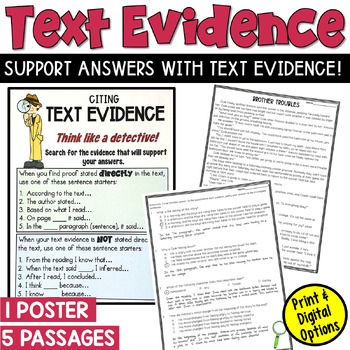
Teaching students to find text evidence to support their answers is an important reading strategy and test taking strategy. This post contains a FREE text evidence lesson!  It includes text evidence sentence starters, a free reading passage, and other text evidence activities.


Thank you for stopping by!
~Deb


Pin for future reference:
Teach students to support their answers by citing text evidence.This blog post includes free printables so that you can replicate the entire lesson with your upper elementary students.

Reviewing Skills with Reading Games!

Friday, December 21, 2018
Have you ever heard the saying "With one polka dot, nothing can be achieved"? This saying speaks to the power of repetition. Most teachers agree that repetition plays an important role in education. If a teacher attempts to teach an objective one isolated time during a school year, chances are good that few students (if any) will remember that objective at the end of the school year. However, if a teacher periodically reviews and builds upon the objective after the initial lesson, the likelihood that students WILL retain what they learned increases. That's why the concept of a spiral curriculum is such a hot educational topic. Plus, it's the main reason why we teachers like to review concepts before our students are required to take standardized tests.

Make reading test prep meaningful and fun by using reading games! After reading a passage, students will answer 6 multiple choice questions and try to earn the lowest number of points. This blog post contains a FREE nonfiction reading passage!


A few weeks ago, I decided that I wanted to create some engaging reading activities where students would be reviewing important reading skills they have already learned. In order to make them engaging, I decided to add a competitive element so that students would view them as games.

I was quite pleased with the end result! The picture below shows 1 of 12 nonfiction passages in my 4th/5th grade set.

Make reading test prep meaningful and fun by using reading games! After reading a passage, students will answer 6 multiple choice questions and try to earn the lowest number of points. This blog post contains a FREE nonfiction reading passage!

UPDATE!  These games are now available in a digital format (Google Slides), as well!  

MATERIALS NEEDED (Print Version)

Each student needs:
  • Reading passage
  • Die
  • Pencil
  • Red pen or marker

Each group needs:
  • Directions
  • Answer Key


DIRECTIONS FOR PLAYING (Print Version)

  • Choose how many students you want to compete in each group. I have mainly played this game with groups of 2 to 4 students, but you could certainly play with a larger group, as well.
  • Distribute the passage to everyone in the group, and tell them to read it carefully. (Also tell your students that if they finish reading it early, they should not start answering the questions yet!)
  • When everyone has finished reading the passage, instruct each student to pick up a die, roll it, and then record a tally mark on the line beneath the passage. (Students will add a tally EACH time they roll the die.)
  • Tell students to answer the numbered question that matches the number shown on the die. (For example, if Student A rolled a 4, she should answer Question #4.)
  • Instruct students to roll the die again and record a tally mark. 
    • If a student rolls the number of a question that has already been answered, he or she should immediately roll the die again.
    • If a student rolls the number of a question that has not yet been answered, he or she should go ahead and answer the question.
  • When a student finishes all six questions, the number of tallies at the bottom of the page should be counted and that number should be multiplied by 2. 
  • When everyone in the group has finished answering the questions, have students check their answers together.
  • Students should record the number of correct and incorrect answers at the bottom of the page, and multiply accordingly. 
  • Instruct students to determine the grand total by adding the three subtotals.
  • The person(s) with the LOWEST GRAND TOTAL is the winner!
Make reading test prep meaningful and fun by using reading games! After reading a passage, students will answer 6 multiple choice questions and try to earn the lowest number of points. This blog post contains a FREE nonfiction reading passage!
Print this page for student reference.


DIRECTIONS FOR PLAYING (Google Slides Version)

The rules are the same as above. The main difference is that there is a dice-rolling option in the menu bar, so students do not have to roll a real die (unless they want to!) As you can see, each question has its own slide, and there is also a slide at the end of the game that guides students through the process of determining their score.


FREE GAME

Click here (or on the image below) to download one free nonfiction game. This game includes both the print and the digital version!

Make reading test prep meaningful and fun by using reading games! After reading a passage, students will answer 6 multiple choice questions and try to earn the lowest number of points. This blog post contains a FREE nonfiction reading passage! Skills include main idea, text structures, context clues, cause and effect, citing text evidence, and vocabulary.


MORE GAMES ARE AVAILABLE!

Click on any of the images below to check out the reading games I have available in my TpT store! Each set includes 12 reading passages!
These reading games are perfect for test prep! This set includes 12 fiction passages. After reading each passage, students answer 6 multiple choice questions. Reading skills include theme, character traits, context clues, cause and effect, figurative language, and more!


These reading games are perfect for test prep! This set includes 12 nonfiction passages. After reading each passage, students answer 6 multiple choice questions. Reading skills include main idea, context clues, text structures, cause and effect, affixes, and more!


These reading games are perfect for test prep! This set includes 12 nonfiction passages. After reading each passage, students answer 6 multiple choice questions. Reading skills include main idea, context clues, text structures, cause and effect, affixes, and more!


These reading games are perfect for test prep! This set includes 12 fiction passages. After reading each passage, students answer 6 multiple choice questions. Reading skills include theme, character traits, context clues, cause and effect, figurative language, and more!


Pin for future reference:
Make reading test prep meaningful and fun by using reading games! After reading a passage, students will answer 6 multiple choice questions and try to earn the lowest number of points. This blog post contains a FREE nonfiction reading passage and game! They are available in printable format and Google Slides format!


Targeting Reading Skills with Small Group Instruction

Wednesday, June 13, 2018
Small group instruction and targeted intervention is known to improve reading comprehension skills. Learn about my Targeted Tri-folds designed for upper elementary students and why teachers love it. These trifolds target ten different reading skills, including main idea, context clues, making inferences, author's purpose, and much, much more! Reading Comprehension
Teachers who implement small group instruction activities understand the numerous benefits associated with working with a limited number of students. A few of the benefits include:

  • a reduced student-teacher ratio. Rather than trying to simultaneously meet the various needs of 30-some students at once, the teacher can focus on breaking down concepts based on the needs of 2-6 students.
  • targeted skill instruction. When a handful of students who are struggling with a certain skill are pulled aside, the teacher can provide in-depth instruction related to that particular skill.
  • individualized learning. When a teacher is focused on the needs of a small handful of students at one time, he or she can easily assess which aspects of a skill have been mastered, and which aspects will require additional learning opportunities and supports in order to eventually reach a level of mastery.
  • increased student engagement. In a large group setting, there will always be students who are able to mask their true understanding of a skill by "flying under the radar". However, when students are engaged in small group instruction, they are required to be actively involved in each lesson. Furthermore, students are often willing to ask more questions in order to clarify a confusing concept in a small group setting.

Interactive Digital Task Cards!! {FREEBIE included!}

Tuesday, May 16, 2017
Find out about the new task card technology called Boom Learning! These task cards contain so many innovative features that you have to see for yourself!
Less than a decade ago, I didn't even know what a "task card" was. Now, however, I can't imagine teaching without them! They are so student-friendly, and they can be used in SO many different ways!

Now... get this... new technology has allowed task cards to be IMPROVED! The talented people at Boom Learning have found a way to create digital task cards that students complete online!! And to make it even easier, they have joined forces with TeachersPayTeachers! A set of Boom Cards can be purchased on TpT, and after you purchase, a link transports you right to the Boom Learning platform where the digital task cards are housed. (Full disclosure: I am receiving a free renewal for writing a blog post about Boom Learning.)

Boom Cards are truly incredible! Why? Let me share a short list of just some of the awesome features provided by Boom Cards:

  1. Boom Cards are paperless! That means that no printing, no cutting, no laminating, and no storing is required! 
  2. Boom Cards are innovative! At my recent school, my principal was thrilled whenever a teacher implemented a new type of technology into their classroom activities. 
  3. Boom Cards provide immediate feedback! After a student answers each question, he is informed immediately whether his answer is correct or incorrect. Students who choose an incorrect answer are given an opportunity to answer again.
  4. Boom Cards are student-friendly and engaging! They feel like any other educational app that you might find on an electronic device. Kids can earn badges and awards. They can even sign in from home to access the cards, and do them with a parent! 
  5. Boom Cards are teacher-friendly! Once a teacher sets up an account, he or she can add students and then assign a deck to individual students or to the entire class. Because the task cards are self-checking, the teacher can access reports that tells how each student did on the assigned decks.
  6. Boom Cards are versatile! They work on any device... SMARTBoards, iPads, desktop computers, phones, etc. Furthermore, Boom Cards can be used in multiple ways! Students can complete them individually at their desks, iPads can be set up at a learning center, or your entire class can work through them together as a large group activity using the Fast Play option!
During this launch period, Boom Learning is providing a one-year subscription to every teacher for FREE! After the year has passed, you can either renew your subscription in order to access the premium features, or you can continue to play all of your decks for free using the Fast Play option!

I encourage you to check out a deck for yourself! These truly unique task cards can best be understood by exploring a deck. Feel free to explore my FREE Boom Card deck that focuses on possessive nouns. Just click on the image below to check it out!
FREE digital task cards! This set focuses on singular and plural possessive nouns.

I currently have a few decks available in my TpT store, and I hope to add more in the coming months. Click HERE to view my current listing of Boom Cards.

Interactive digital task cards! Find out about this unique and innovative way to facilitate task card use in your classroom!

If you try them out, please let me know what you think! I hope you and your students love them as much as I do!


FREE Synonym and Antonym Lesson for Upper Elementary

Wednesday, March 2, 2016

Today is my day to post at Upper Elementary Snapshots! Click on this link to read about how I teach my students to attack synonym and antonym multiple choice questions on standardized tests when they don't recognize one or more of the vocabulary words in the question. Plus, you'll be able to download this activity for FREE and use it in your own classroom if you wish!
Teach your students three important test strategies for identifying synonyms and antonyms on standardized tests... even when they don't know what a word means! This FREE lesson contains a poster, an exit ticket, and three multiple choice teaching examples!

Have a great day!
Powered by Blogger.
Back to Top